If you watch any good lesson closely, you will notice a pattern: new learning starts with the teacher, moves to the class working together, and ends with each child working on their own. In our classrooms, we call it ‘I do, we do, you do’, and it is one of the most powerful habits in great teaching.
Think of learning to ride a bike
Very few children learn to ride a bike by being handed one and told to get on with it – in fact, that might put them off the idea for life! First, they watch someone else ride; then an adult runs alongside, holding the saddle and letting go a little more each time; and finally, they ride on their own, wobbling at first, but ending up with confidence.
Good teaching follows the same pattern. Researchers call it the ‘gradual release of responsibility’: at the start of new learning, the teacher holds all of it, and hands it over, step by step, as children show they are ready.
What it looks like in a lesson
I do – the teacher models a new skill, thinking aloud as they go: ‘First I…, because…’. Children see not just the answer, but how an expert gets there.
We do – the class practises together, with the teacher guiding. Support is gradually removed: the teacher does less of each example, and the children do more. Every child responds, often on mini whiteboards, so the teacher can see straight away who has understood.
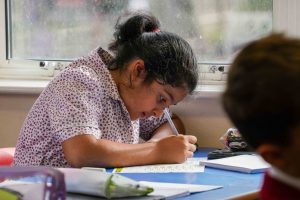
You do – children practise on their own, using what was modelled, while the teacher moves around the room, catching mistakes early.
In a Year 4 maths lesson, that might mean the teacher solving one column addition aloud, the class solving two together on whiteboards, then each child completing a few on their own. In Year 6 English, the teacher might write a persuasive paragraph live, narrating each choice, before building the next one with the class and then asking children to write their own.
Why it works
Children who are new to an idea can only hold a little in their heads at once, so asking them to work something out alone, before they have seen how, can overwhelm them – they guess, make mistakes and lose confidence. Seeing a clear model first, then practising with support, lets them focus on the learning itself. It is one of the most consistent findings in research on how children learn, and it sits at the heart of Rosenshine’s Principles of Instruction, upon which our Teaching & Learning Toolkit is built.
This process is a routine, not a script, and children move on when they are ready, not when the clock says so. Some lessons loop back – ‘I do’, ‘we do’, then ‘I do’ again – before children are ready to work alone. That is not a lesson going wrong; it is teaching responding to what children need.
Building resilience, one step at a time
The approach doesn’t just help children learn the content; it shapes how they feel about challenge. Resilience grows from experience: from tackling something hard and finding that, with effort, they can do it. And effortful thinking and practice are hard!
That is why the order matters. If children are asked to work alone before they are ready, struggle can quickly turn into ‘I can’t do this’. When they have seen a clear model and practised with support first, the challenge of the ‘you do’ feels within reach. They still have to think hard and persevere, but they do so believing they can succeed, and each success makes them more willing to have a go next time.
The opposite is true as well. When adults do everything for a child, however kindly it is meant, the child never reaches the ‘you do’. They miss the chance to struggle a little, work it out and feel the satisfaction of having done it themselves. Over time, they can come to believe they need an adult to step in, and they become less willing to try something difficult on their own. Support only helps when it is gradually taken away.
Mistakes are part of the process too. In the ‘we do’, errors are spotted and talked about openly, as a normal part of learning rather than something to hide. Children learn that getting something wrong is simply a step on the way to getting it right.
Trying it at home
The same approach works beyond the classroom, whether it is a new recipe, a tricky homework question or learning to tie shoelaces:
Show them first – do it yourself and talk through what you are doing and why (this ‘think aloud’ is your most powerful tool for modelling).
Do it together – let them take over a step at a time, with you alongside, giving feedback that helps them move forward.
Then step back – let them try on their own, even if it takes longer or isn’t perfect.
The hardest part is often the last one, but stepping back is what turns help into independence.
From supported to independent
The aim of every ‘I do’, ‘we do’ and ‘you do’ is for children to be able to work confidently on their own, and to keep going when something is difficult. Independence and resilience aren’t qualities children are simply told to have. They are built, carefully and deliberately, one step at a time – that is pedagogy in action.