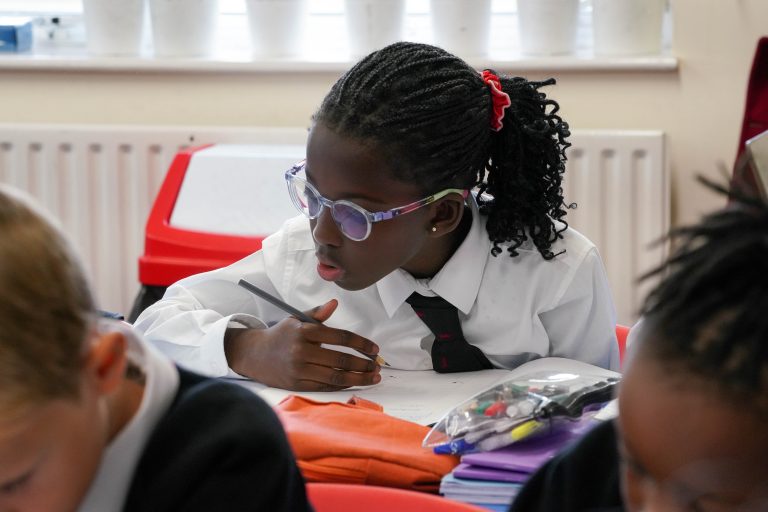
Every autumn, as cognitive potential scores (often known as CATs or QCPs) arrive home, one question comes up more than any other: how can we improve them? It’s a natural thing to ask, and the answer lies in how children are taught to think, every lesson, every day.
A snapshot, not a ceiling
Cognitive potential assessments give a snapshot of how readily a child reasons with words, numbers and shapes. For teachers, they are a valuable tool. They show how each child learns best, and whether their attainment matches their potential.
They are not, however, something to revise for. Practising test-style questions can give a small, short-lived boost from familiarity with the format, but it doesn’t make children better thinkers. What makes the real difference is knowing more, understanding more and having plenty of practice in using that knowledge to reason, explain and solve problems.
We think with what we know
Research in cognitive science points to something simple but powerful: learning is a change in long-term memory. Working memory – sometimes called ‘short-term’ memory, the part of the mind that holds ideas while we think about them – is small and easily overloaded. Long-term memory, by contrast, is vast. The more knowledge and vocabulary a child has securely stored, the more mental space is free for the hard part: making connections, spotting patterns and tackling new problems. Children remember what they have thought hard about, and what they have returned to many times, in different ways, over time. Every lesson at Copthorne is designed with that in mind.
Inside a Copthorne lesson
Our Teaching & Learning Toolkit, built on Rosenshine’s Principles of Instruction and the latest research on how children learn, sets out what we expect to see in every classroom. If you step into a Copthorne lesson, you will see:
Retrieval first – lessons open with a few minutes of silent recall from memory: last lesson, last week, last term. Each time learning is brought back, it gets stronger.
Clear goals – children know exactly what they are learning and what success looks like. They check their own work against success criteria printed in their books.
Expert thinking made visible – teachers model new learning in small steps, thinking aloud as they go. Children see how an expert approaches a problem before they try it themselves.
Questions that make everyone think – ‘Why?’ ‘How do you know?’ ‘What would happen if…?’ Every child is expected to answer, with time to think first.
Talk – through ‘think, pair, share’, children explain their reasoning in full sentences, using precise vocabulary. Putting thinking into words deepens it.
Words worth knowing – key vocabulary is taught explicitly, and talk is scaffolded with sentence stems and speaking frames, because words children can explain and use are words they can think with.
Thinking about thinking – before a task, children ask themselves: What do I need to help me? Why will it help? How will I use it? Developing metacognition in this way helps to create resilient, adaptable learners, ready for whatever new material they face.
A curriculum built for thinking
This approach runs through our Horizon Curriculum. Learning is organised around enquiry questions that grow more demanding as children move up the school, with Global, our integrated humanities subject, at its heart. Subjects connect, so children link ideas rather than learning facts in isolation. It is a curriculum designed to teach children how to think, not just what to know.
The best support at home is simple
Families often ask what they can do at home. The most effective things need no worksheets at all:
Read together every day – reading builds the knowledge and vocabulary that all thinking depends on.
Ask ‘why?’ – invite children to explain their thinking, not just give an answer.
Ask what they remembered – ‘What’s one thing you remembered in maths today?’ Recalling the day’s learning over dinner strengthens it but avoid huge, broad questions (they won’t tell you anything if the scope is too wide!).
Let them wrestle with it – thinking hard should feel effortful, so resist the urge to rescue too quickly. This applies to learning beyond the classroom, too – children feel successful when they have been able to solve a problem, not when it’s been solved for them, and that lays the foundations for challenge and risk-taking as they grow.
Praise the process – effort, persistence and good reasoning matter more than any single score.
Trusting the process
Strong thinkers aren’t made overnight, and they aren’t made by drilling. They are built steadily, lesson by lesson, through secure knowledge, rich talk and well-designed teaching. That is the approach at the heart of Copthorne’s curriculum and classrooms, and it is why we can say with confidence: trust the process.